FOR IMMEDIATE RELEASE

Washington, D.C. - May 30, 2025

Media Contact:
[email protected]

925-766-9050

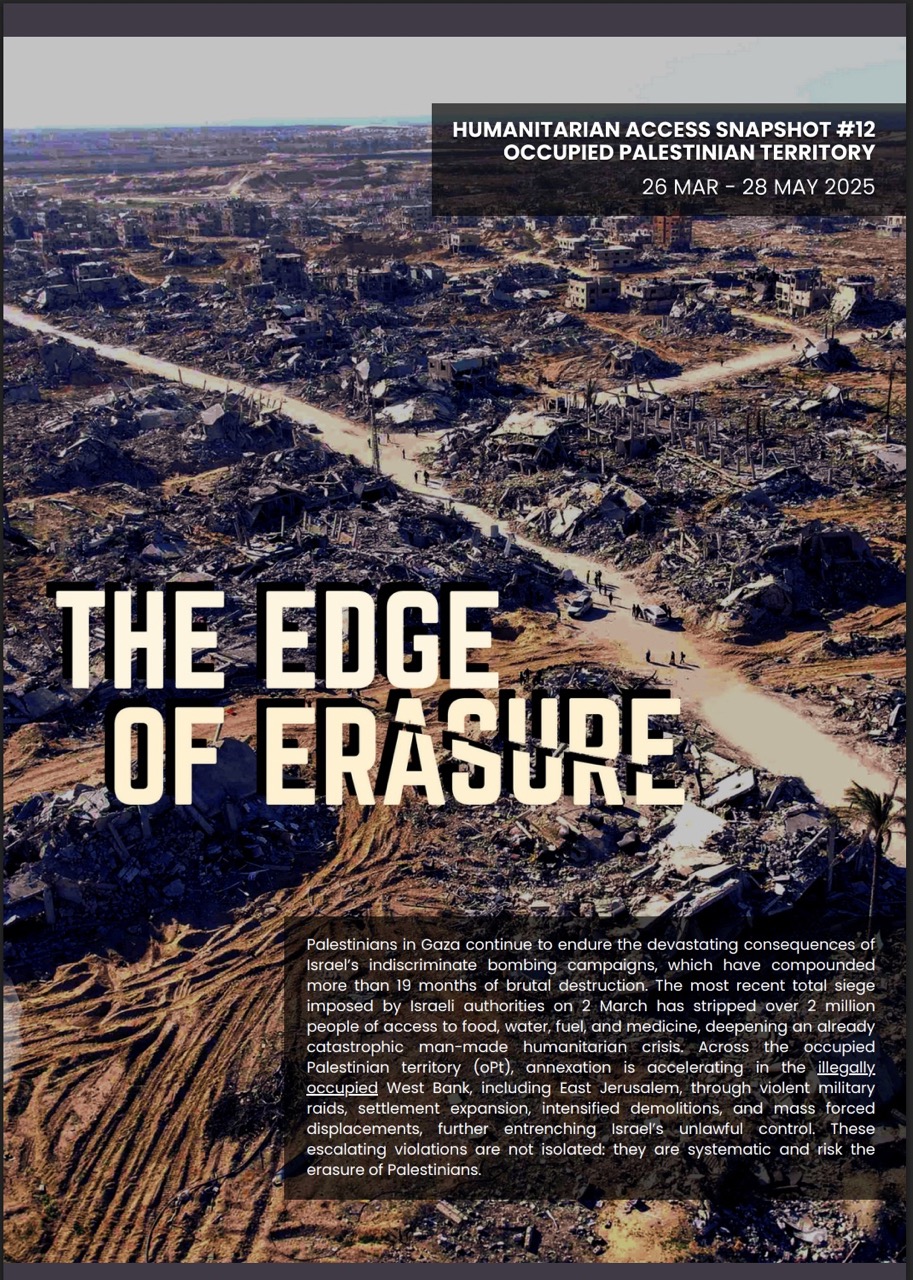
Churches for Middle East Peace (CMEP) joins International Aid Agencies in Issuing Gaza Humanitarian Snapshot #12 "The Edge of Erasure"

30th May 2025 Washington D.C.- Churches for Middle East Peace (CMEP), alongside dozens of international aid and development agencies, released its latest Humanitarian Access Snapshot, covering the period from March 26 to May 28, 2025.

The people of Gaza continue to endure the devastating consequences of Israel’s indiscriminate bombing campaigns, which have compounded more than 19 months of brutal destruction. The most recent total siege imposed by Israeli authorities on 2 March stripped over two million people of access to food, water, fuel, and medicine, deepening an already catastrophic man-made humanitarian crisis. Across the rest of the occupied Palestinian territory (oPt), annexation is accelerating in the illegally occupied West Bank, including East Jerusalem, through violent military raids, settlement expansion, intensified demolitions, and mass forced displacements, further entrenching Israel’s unlawful control. These escalating violations are not isolated; they are systematic and risk the erasure of Palestinians.

Nearly three months have passed since Israeli authorities imposed another total siege on Gaza on 2 March. On 19 May, the Israeli cabinet approved a decision to allow “basic” food into Gaza. This is merely a drop in an ocean of needs. Conditions imposed by Israeli authorities continue to prevent large-scale humanitarian aid delivery. Of the small amounts of aid that have been allowed to enter Gaza, very little has actually reached families. In the face of such systematic devastation –  widespread injuries and illness combined with acute malnutrition, and dehydration, poor sanitation, and the growing threat of waterborne disease, and virtually no sanitation – deaths from these intersecting conditions will soon accelerate, and will not be prevented by token and piecemeal deliveries of food parcels under any militarized supply distribution scheme. Only a comprehensive, multi-sectoral response at scale can even start to address the overwhelming, man-made humanitarian crisis. 

46 international and Palestinian NGOs participated in a survey sharing their experiences delivering humanitarian aid and services from 26 March to 9 May. From those, 40 operate in Gaza, 29 in the West Bank and 23 have operations across the entire oPt. While the results do not capture every NGO operating in the oPt, they reflect the deteriorating operating environment and the range of obstacles to delivering aid. 

Key Findings:

Of the 40 surveyed organizations working in Gaza…

  • 93% reported they have exhausted or nearly exhausted their aid stocks inside, while miles of aid are blocked from entering Gaza from outside.
  • Two-thirds reported being unable to reach and deliver services to communities in need 
  • One-third reported staff injuries or deaths due to attacks by Israeli forces in Gaza

Of the 29 surveyed organizations working in the West Bank…

  • 93% say they faced increased movement restrictions in the West Bank, with settler attacks and military raids escalating across northern governorates, impacting their ability to reach communities in need. 
  • 38% reported having had suspended or reduced their operations in the West Bank
  • 48% reported being unable to reach communities in parts of the West Bank.

“The international community must no longer turn a blind eye to the mounting atrocities and deliberate obstruction of life-saving aid in Gaza and the West Bank,” said Rev. Dr. Mae Elise Cannon, Executive Director of Churches for Middle East Peace. “The conditions outlined in this report are not the result of a natural disaster or scarcity—they are the consequence of intentional policy choices being made by the Israeli government and being allowed by the world. Failing to act now is complicity in the collective punishment of millions.”

As a coalition of 36 national church denominations and organizations, CMEP remains steadfast in its advocacy for a just peace in the Holy Land and an end to the violence and occupation that fuel such humanitarian catastrophes.


###

Formed in 1984, Churches for Middle East Peace (CMEP) is a coalition of more than 30 national church communions and organizations, including Catholic, Orthodox, Protestant, and Evangelical traditions that works to encourage US policies that actively promote a comprehensive resolution to conflicts in the Middle East with a focus on the Israeli-Palestinian Conflict. CMEP works to mobilize US Christians to embrace a holistic perspective and to be advocates of equality, human rights, security, and justice for Israelis, Palestinians, and all people of the Middle East.


Recent CMEP Statements and Press Releases:

May 20, 2025: CMEP Affirms Statement by Israeli Civil Society Groups calling for Ceasefire and entry of Aid into Gaza
Churches for Middle East Peace (CMEP) expresses its full support for the recent statement issued by Israeli human rights organizations calling for the immediate and unconditional end to Israel’s blockade on humanitarian aid to Gaza. Prime Minister Netanyahu’s decision to allow “basic amounts of food” into Gaza resulted in only five aid trucks entering the besieged territory on the first day, Monday, May 19, 2025. While this gesture has been cited as a measure of relief, this token action falls woefully short amid the spiraling famine and widespread nutritional deficiencies facing the vast majority of Gaza’s population. CMEP calls on the U.S. government and the international community to exert urgent and sustained pressure on the Israeli government to end its policy of starvation and to immediately open all crossings for the unrestricted delivery of humanitarian aid. We reject the U.S.-Israeli proposal to oversee limited aid distribution, as it fundamentally fails to meet the scale of need and does not adhere to internationally recognized humanitarian principles. The time for partial solutions has long passed—comprehensive, unimpeded aid access is both a moral and legal imperative.

Apr 30, 2025: CMEP Executive Director Rev. Dr. Mae Elise Cannon Spends Holy Week in Israel and the Occupied Palestinian territories
CMEP’s executive director traveled to the occupied West Bank including East Jerusalem for Holy Week from April 11 to 20, after leading a multi-faith delegation in Jordan and Egypt. Rev. Dr. Mae Elise Cannon, Executive Director of Churches for Middle East Peace (CMEP), visited numerous local church leaders to stand in solidarity with the Christian community in the occupied Palestinian territories and Israel during Holy Week. Her visits included high-level meetings with Christian, Muslim, and Jewish community leaders and focused on ending the devastation and destruction in Gaza.

Apr 25, 2025: CMEP Elevates the Statement of The Evangelical Lutheran Church in America
Churches for Middle East Peace (CMEP) emphasizes the recent statement from the Evangelical Lutheran Church in America (ELCA) and the Evangelical Lutheran Church in Canada, which affirms their deep commitment to solidarity with Christian partners in the Holy Land. During this historic Holy Week delegation, Rev. Dr. Mae Elise Cannon, Executive Director of CMEP, was honored to meet with Bishop Dr. Sani-Ibrahim Azar of the Evangelical Lutheran Church in Jordan and the Holy Land (ELCJHL). Their time together included meaningful dialogue about the ongoing witness of the Christian church in the region and how our respective ministries might deepen partnership in our shared mission to embody the love of Christ and pursue a just and lasting peace for all people in the Holy Land.


See all of our public statements and press releases.


Contact Us

Churches for Middle East Peace (CMEP)
110 Maryland Ave NE, Suite 505
Washington, District of Columbia 20002
(202) 543-1222  [email protected]

Follow Us


Unsubscribe or Manage Your Preferences