Here’s what’s upcoming and what you may have missed at CMEP and in the news.
Middle East News
1. Iran says Strait of Hormuz under its control, rejects Trump claims
Al Jazeera
"The commander of the paramilitary Basij Organisation said the Strait of Hormuz is 'under Iran’s control and management,' a day after President Donald Trump claimed the United States was in 'total control' of the waterway. 'Today you see that the Strait of Hormuz is under the management and control of the Islamic Republic, and our country continues on its path in complete security,' Hojjatoleslam Hossein Taeb said in remarks on Thursday quoted by Iran’s semi-official Fars news agency. 'The Americans saw the power of the Islamic revolution,' he added."
2. Gaza cancer patients face rising death rate amid Israeli curbs, doctors say
Reuters
"Gaza cancer patients are dying at two to three times the pace they did before the start of the war in the territory, as Israel blocks many from traveling for treatment after destroying the only local specialized facility, Gaza doctors said. Israel blew up Gaza's specialized cancer hospital last year after saying troops found a tunnel used by Hamas militants running beneath it. That means that an estimated 17,000 Gazans with cancer have no local option for chemotherapy or other advanced therapy. Few Palestinians can afford to travel for treatment, and those who can face Israeli restrictions. The military imposes strict caps on daily crossings to Egypt, despite a 2025 Israel-Hamas ceasefire deal that requires free movement in and out."
3. In West Bank Village, a New Israeli Order Enables Settler Attacks While Claiming to Prevent Them
Drop Site News
"On Sunday, the Israeli military declared the Palestinian village of Taybeh in the occupied West Bank a closed military zone, claiming the order was aimed to prevent escalating attacks by marauding Israeli settlers. It ostensibly bars Israelis and foreigners from entering the area. But residents of the village and the surrounding area told Drop Site News that the military order is designed to further isolate Taybeh from the outside world, barring solidarity activists from the area while allowing settler attacks to continue. One of the few Christian-majority Palestinian villages in the West Bank, Taybeh has come under growing attacks by Israeli settlers who have expanded colonial outposts encircling it over the past several weeks."
4. US ambassador condemns ‘Israeli terrorists’ for siege of Palestinian American home
The Hill
"U.S. Ambassador to Israel Mike Huckabee said the U.S. requested Israeli security forces remove 'Israeli terrorists' from besieging a Palestinian village and the home of a Palestinian American, condemning the actions as criminal and an act of terror. Huckabee’s statement marks an unusually strong response from the Trump administration related to Israeli settlers. The ambassador supports Israeli settlements in the West Bank, and President Trump previously dropped sanctions against violent Israeli settlers imposed by the Biden administration."
5. West Bank Christians feel ‘forgotten’ over settler violence
Vatican News
"'Do not forget Taybeh! Taybeh must not vanish into silence.' That's the urgent plea issued by Father Bashar Fawadleh, describing the harsh reality in Palestine's last entirely Christian village. In Taybeh—mentioned in the Bible under the name Ephraim, where Jesus and his disciples are said to have sought refuge—the local community is now facing systematic intimidation, property seizures, and encroaching settlements. This Sunday, the Israeli military declared Taybeh closed to non-residents, effectively blocking Israelis from entering the Palestinian town. According to a military spokesperson, the restriction applies solely to Israelis, not Palestinians, and was enacted to 'protect residents in the area' following 'several violent attacks by Israelis in the region.'
6. US pushes back as Katz says IDF will not withdraw from security zone in southern Lebanon
The Jerusalem Post
"After Defense Minister Israel Katz declared that the IDF 'will not withdraw' from the security zone and ordered the military to prepare for a long-term presence, Washington clarified that 'a permanent military presence in southern Lebanon is inconsistent with the commitments' made under the understandings. However, an Israeli withdrawal would be contingent on the verified disarmament of Hezbollah and the dismantling of its infrastructure. A senior US State Department official responded overnight on Thursday to remarks by Katz, who said during a visit to southern Lebanon that the IDF would not withdraw from the 'security zone' and that he had instructed the military to prepare for a long-term presence in the area. The official clarified that, from Washington's perspective, a permanent Israeli military presence in southern Lebanon is inconsistent with the commitments made under the understandings."
7. Former Syrian President Assad sentenced to death in absentia for war crimes
AP News
"A Syrian court on Tuesday sentenced ousted President Bashar Assad and his brother in absentia for murder, torture and crimes against humanity committed before and during the country’s 14-year civil war that left about half a million people dead. The verdicts by a court in Damascus are the first against Assad or any members of his inner circle since his family’s five decades in power came to an end 20 months ago. They are mostly symbolic, however, because Assad and his brother Maher had fled to Russia, where they received asylum after the Syrian government’s stunning collapse in December 2024."
8. Colombia’s far-right government recognizes Israeli claim over Golan Heights
Al Jazeera
"Colombia has recognized Israel’s claim of sovereignty over the occupied Syrian Golan Heights, just days after far-right President Abelardo de la Espriella took power. Colombia’s Foreign Ministry made the announcement on Monday, joining the United States as the only other country to recognize Israel’s annexation of the territory in 1981. 'The Government of Colombia recognizes Israeli sovereignty over this territory, as well as that State’s right to protect itself against external threats,' read a statement published on X. 'Colombia recognizes that maintaining Israel’s control and sovereignty over the Golan Heights is an essential component of its national defense,' it added. Israeli Foreign Minister Gideon Saar thanked his 'good friend' de la Espriella for the 'historic' recognition."
9. Iran-backed Houthi rebels clash with Yemeni government forces and other Mideast developments
AP News
"Clashes between Iran-backed Houthi rebels and government forces in Yemen raged overnight and into Thursday, raising fears that the country’s civil war could reignite and open another front in the Middle East. At least one government soldier was killed and another critically wounded in clashes with the Houthis in the mountainous province of Taiz, Yemeni military officials told The Associated Press. The fighting came as part of a spate of recent Houthi attacks on government-held areas across the country. Dozens of government troops have been killed since last week, the Yemeni military said. The Houthis also said they launched another drone attack on an Aramco oil refinery in Saudi Arabia. Saudi officials did not immediately comment on the reported attack in the city of Jazan. Last weekend, the Houthis fired drones at the refinery, where the Saudi Energy Ministry reported a fire but no casualties."
As the IDF moves further into Gaza, it is forcing the entirety of Gaza’s remaining population into just 30% of the strip’s area, where the medical situation grows increasingly untenable. It is in this environment of shortage and restriction that the East Jerusalem Hospital Network (EJHN) operates and makes its vital impact. They are the only hope for Gazans, and even West Bankers, in need of sustained, complex treatment for their survival. To secure funding and ensure EJHN can continue to serve the vulnerable of the West Bank and Gaza, urge your Member of Congress to pressure the State Department to allocate the EJHN funds.
Action Alert: Tell Congress to Respond to Settler Violence and Protect Palestinian Lives
Since October 7th, 2023, illegal Israeli settlements have grown and spread across the West Bank in complete contravention of international and even Israeli law. These settlements undermine Palestinian access to critical natural resources and land and undermine hope for a just and lasting solution. Furthermore, the Israeli settlers at the forefront of these illegal land grabs assault Palestinians with almost no punishment from the Israeli justice system — and many times are aided by the Israeli Defense Forces (IDF). To stop this violence, Churches for Middle East Peace (CMEP) calls for immediate U.S pressure on Israel to stop approving settlements and prosecute those that commit crimes against Palestinians.
Aug 11, 2026: CMEP Expresses Support for the Armenian Apostolic Church
Churches for Middle East Peace (CMEP) affirms the vital role of the Armenian Apostolic Church in the spiritual, cultural, and historical life of the Armenian people and in the wider Christian family. We are deeply concerned about undue interference in the internal affairs of the Church and urge respect for its independence and sacred mission.
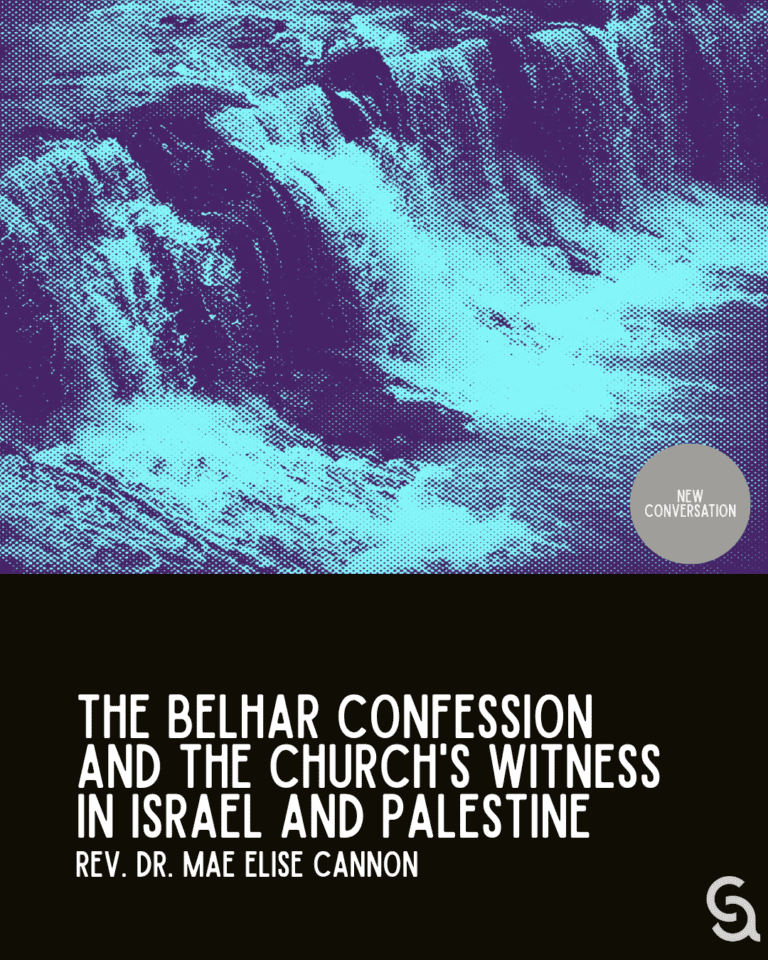
Aug 12, 2026: Written by CMEP: The Belhar Confession: A Witness of the Church in Israel-Palestine
In "The Belhar Confession: A Witness of the Church in Israel-Palestine", published in the Christians for Social Action blog, CMEP Executive Director Rev. Dr. Mae Elise Cannon explores the enduring relevance of the Belhar Confession to the church's witness amid the Israeli-Palestinian conflict. Drawing on the confession's commitments to unity, reconciliation, and justice, she considers how Christians can resist systems of separation and oppression while pursuing a faithful vision of peace and human dignity for all people in the Holy Land.
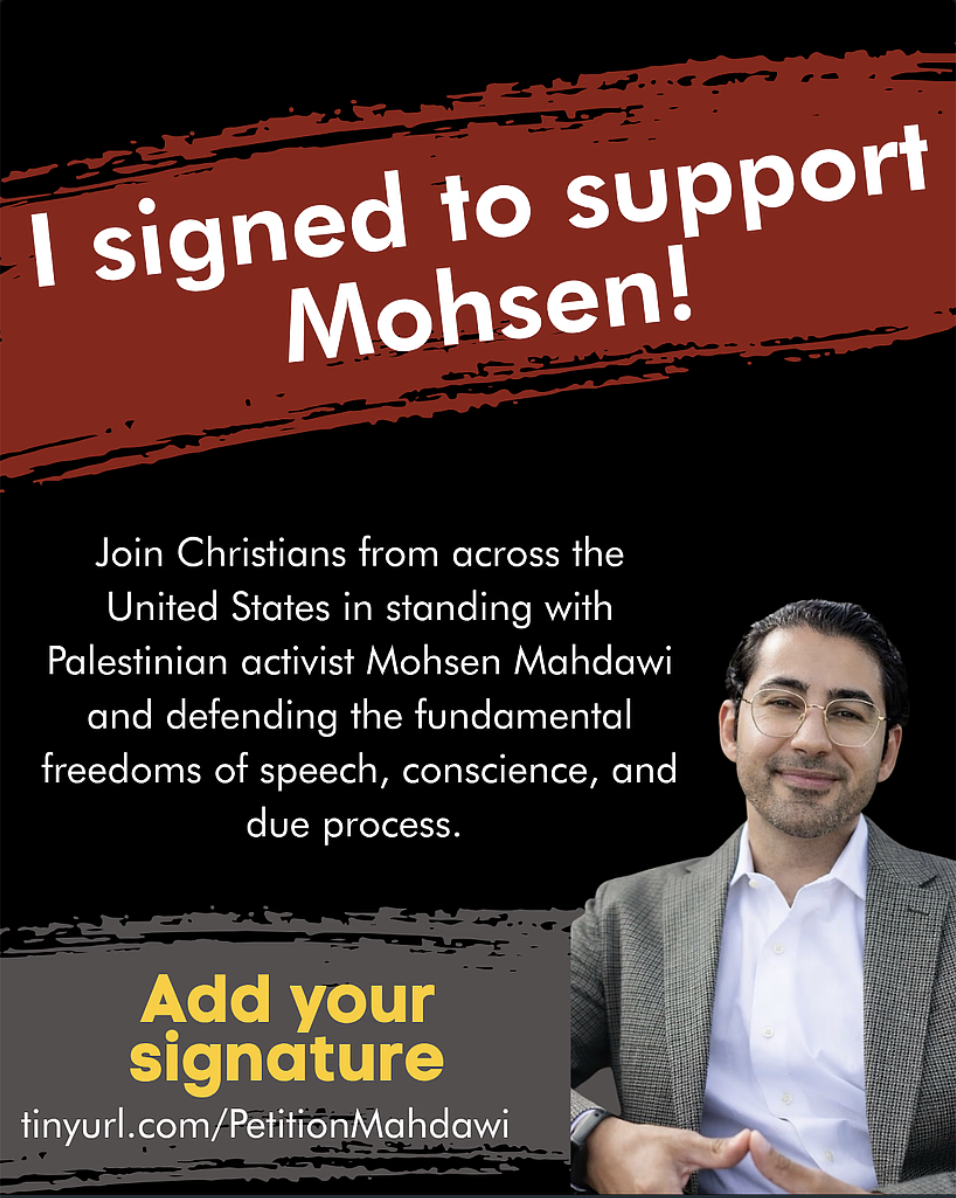
August 5, 2026: Sign-On! Christian Petition Supporting Palestinian Human Rights Advocate Mohsen Mahdawi
Join Christians and Christian organizations from across the United States in standing with Mohsen Mahdawi and defending the fundamental freedoms of speech, conscience, and due process. This letter affirms that no one should face detention or deportation because of their peaceful advocacy or political beliefs. By adding your name or organization, you are standing for justice, human dignity, and the biblical call to protect the vulnerable. Sign today and add your voice to this growing Christian witness.
Blogging for Peace: Follow Rev. Dr. Mae Elise Cannon, Executive Director of CMEP, on Substack
Stay up to date with reflections from CMEP Executive Director Rev. Dr. Mae Elise Cannon. Her Substack features updates on developments in Gaza and across the Middle East, commentary on U.S. policy, CMEP webinars and events, meeting transcripts, and reflections on faith, justice, and peace.
August 23, 2026: Destiny Magnett at Westminster Presbyterian (Wilmington, DE)
Time: 9:30 am - 12:00 pm ET
On August 23, join CMEP’s Destiny Magnett for a guest sermon and post-worship conversation at Westminster Presbyterian Church in Wilmington, DE. First, in her sermon titled Fan Into Flame: Courageous Witness in Trying Times Destiny will explore the calls of 2 Timothy 1:3-14 both from the time in which Paul wrote this letter, and how we might hear its call to courage in the name of the gospel today. Then, after worship, join Destiny for: Faith in Action: Calls to Courage for Israel, Palestine, and the Broader Middle East. This conversation centers the question: How can Christians in the U.S. seek to faithfully bear witness and respond to the crises we see unfolding across the Holy Land today? Attendees will hear updates on the current realities on the ground across the Middle East, and how CMEP and its coalition partners have sought to respond here in the U.S.
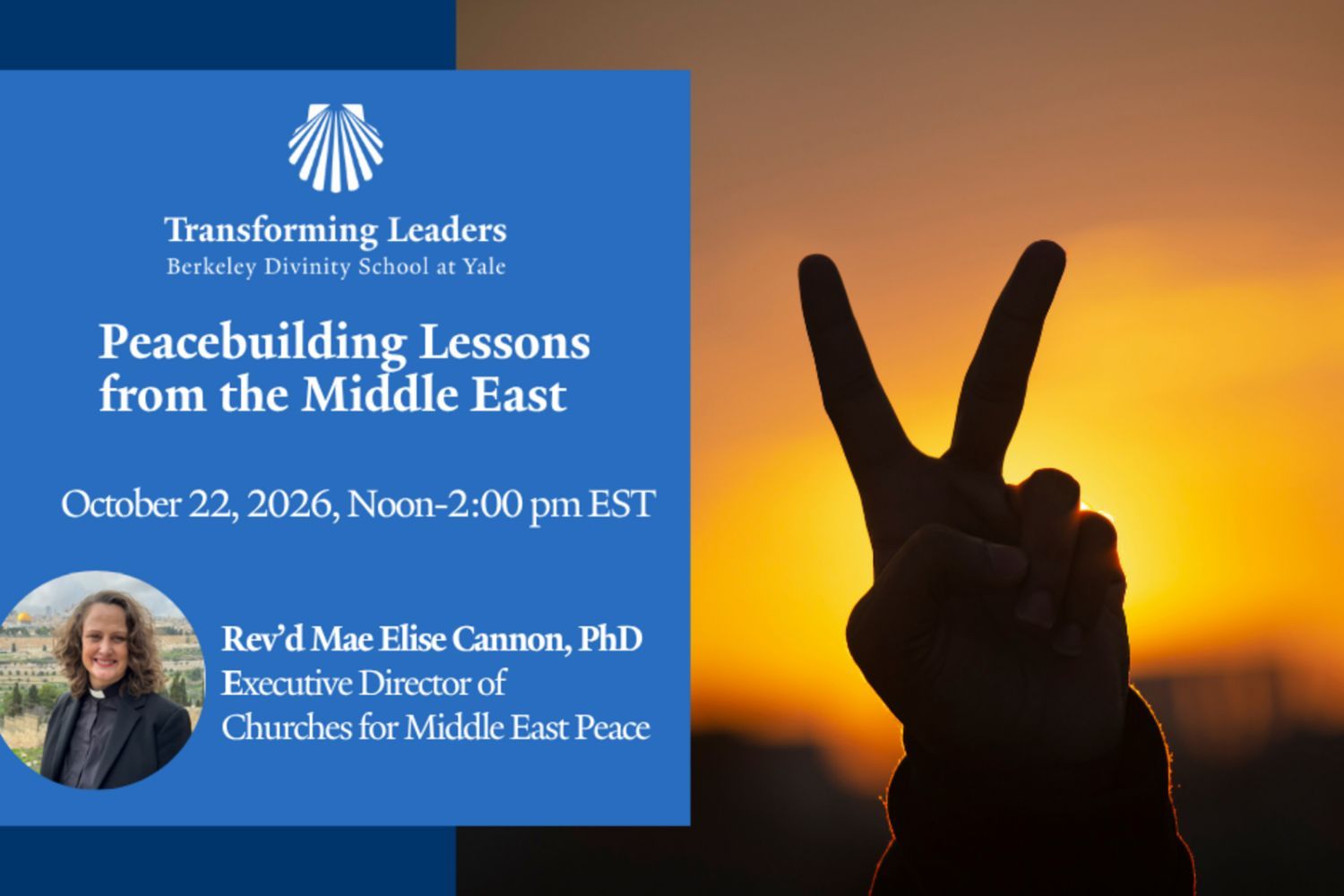
October 22, 2026: Peacebuilding Lessons from the Middle East
Time: 12:00 pm - 2:00 pm ET
This moment in history is marked by profound brokenness and trauma affecting individuals, communities, and nations alike. In a world increasingly divided by conflicts, particularly in the Middle East, Christians from the region offer invaluable insights on resiliently living out one’s faith amidst adversity. Join Churches for Middle East Peace executive director, Rev. Dr. Mae Elise Cannon, for this course exploring the vibrant, living church in the Holy Land, with a focus on Israel and the occupied Palestinian territories as they strive to deepen their relationship with God through their commitment to peace and justice within their communities. This workshop takes an interdisciplinary approach, interweaving history, practical theology, and contemporary ministry practices in peacebuilding. Participants will gain access to essential tools for spiritual formation and advocacy applicable in a variety of ministry settings. A central theme will be the transformative journey of learning to 'love one’s enemy,' even in the face of conflict and strife, ultimately equipping learners to apply these lessons in their own lives and ministries.
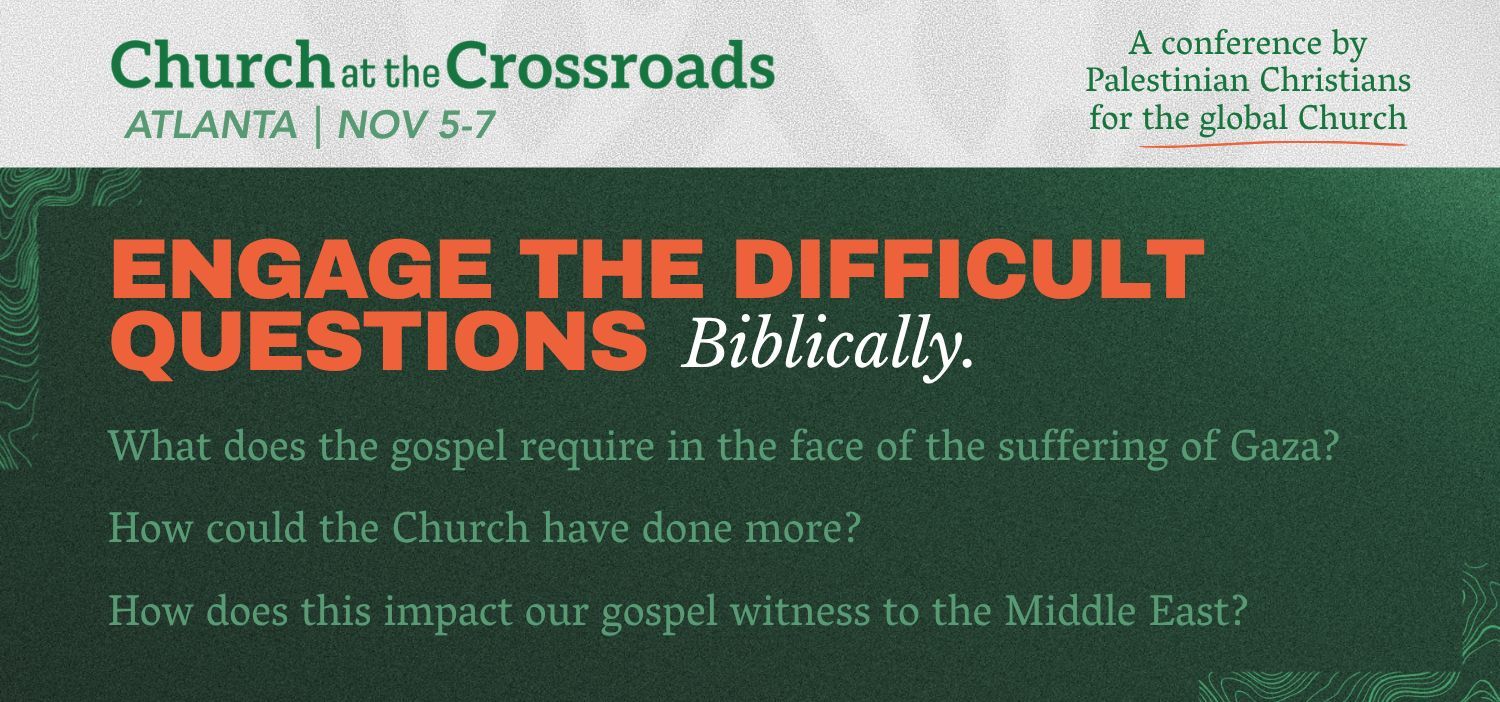
This November, Churches for Middle East Peace (CMEP) is excited to once again partner with the Bethlehem Institute for Peace and Justice (BIPJ) as they bring the Church at the Crossroads conference to Atlanta November 5-7, 2026. Rooted in Scripture and kingdom-focussed theology, this conference invites participants to wrestle honestly with biblical questions, hear directly from the indigenous Church in the Holy Land, and discover faithful discipleship in a violent world.
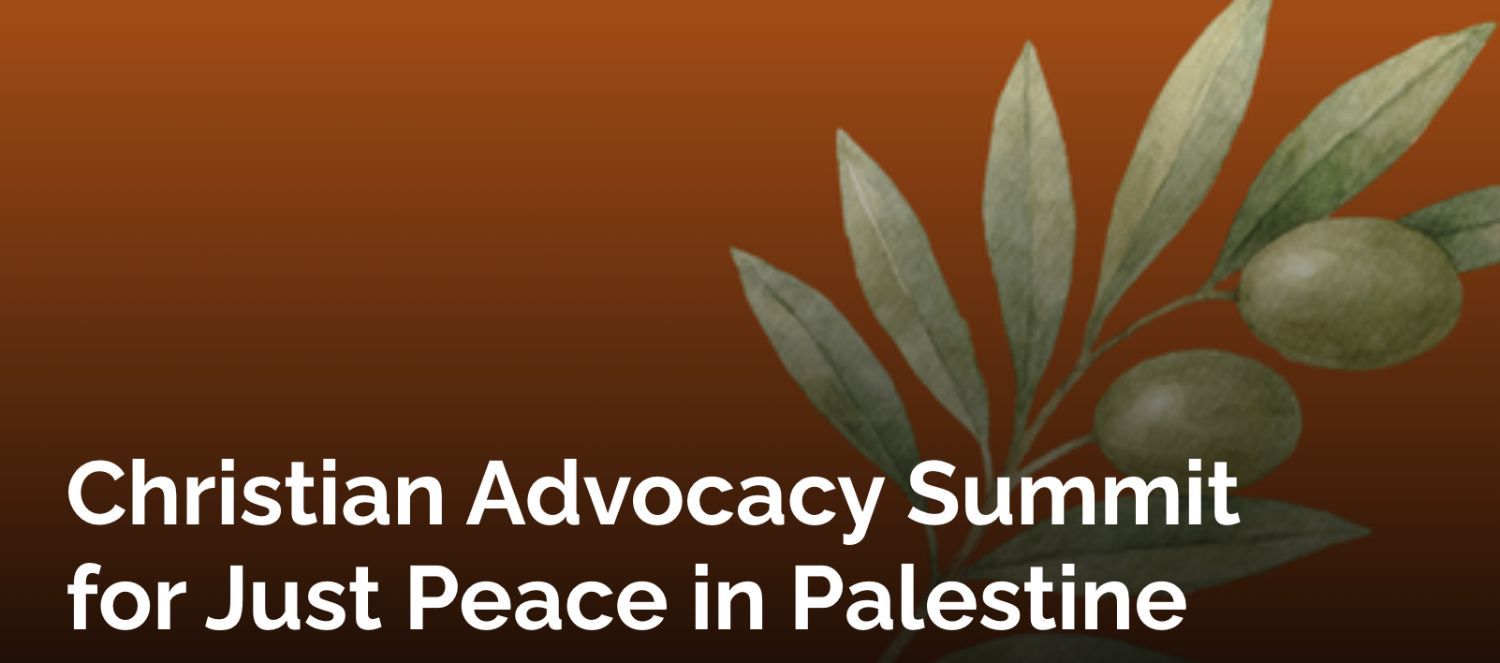
Christian Advocacy Summit for Just Peace in Palestine
Join Christians from across the United States in Washington, D.C. April 19-21, 2027 for the Christian Advocacy Summit as we gather to uphold the cause of the oppressed (Psalm 146:7–9) and advocate for a just peace in Palestine and Israel. Over three days, participants will engage in inspiring plenary sessions, practical breakout workshops, worship, fellowship, and advocacy training focused on advancing U.S. foreign policy that promotes peace, justice, human rights, and equal dignity for all people in the Holy Land. Together, we will strengthen our shared Christian witness and prepare to engage policymakers with a unified call for a just and lasting peace. Discounted early-bird registration is available until October 15, 2026 or until we've sold our first 50 tickets–– so act fast!