Here’s what’s upcoming and what you may have missed at CMEP and in the news.
Middle East News
1. Gaza war’s 1,000 days: 90% of strip ‘destroyed’, 80% ‘seized’ by Israel
Al Jazeera
"More than 90 percent of the Gaza Strip has been destroyed, and Israeli forces are in control of 80 percent of the besieged territory, authorities in the enclave say, as the world marks 1,000 days since Israel’s genocidal war on Gaza began. Tallying up the extent of the damage since Israel launched its war on October 7, 2023, Gaza’s Government Media Office said in a statement on Thursday that at least 73,066 Palestinians have been killed in the enclave. More than 21,500 of those killed in Gaza were children, including 1,022 babies, it added. A further 9,500 people are missing, many believed to be buried under rubble, while 173,514 have been wounded."
2. Rights Group Says Israel Is Killing Palestinian Children in West Bank at Fastest Rate Since 1967
Democracy Now!
"In news from the occupied West Bank, Israeli soldiers killed a 15-year-old Palestinian boy in the city of al-Bireh, near Ramallah, Monday. Amir Ahmad Jawad Jaber was reportedly shot in the head and chest during a raid. This comes as a new report by the Israeli human rights group B’Tselem found Israeli soldiers killed at least 54 Palestinian children and teens in the West Bank last year, in 2025, the highest rate since Israel occupied the West Bank in 1967."
3. Israel and Lebanon sign framework agreement with US in ‘first step’ toward peace, Rubio says
AP News
"Secretary of State Marco Rubio joined Israel and Lebanon’s ambassadors to the U.S. Friday to announce a framework agreement that was described as a first step toward peace following months of conflict between Israel and the Lebanese militant group Hezbollah. The agreement does not include Hezbollah and prompted one of the group’s officials in Lebanon to warn of civil war. The U.S. State Department said the framework establishes a process for dismantling Hezbollah and for Lebanon to regain territory that was taken by Israeli forces as they battled the militant group."
4. Netanyahu in Lebanon: ‘As long as Hezbollah threatens us, we stay’
Yedioth Ahronoth
"Prime Minister Benjamin Netanyahu and Defense Minister Israel Katz visited the security zone in Lebanon on Tuesday, four days after the signing of a framework agreement with Lebanon, and said Israeli forces would remain there as long as Hezbollah continues to threaten Israel. The two were briefed on IDF activity in the area and watched a demonstration of new munitions and weapons designed to counter the drone threat."
5. US and Iran hold separate meetings in Qatar and agree to continue discussions
AP News
"U.S. and Iranian negotiators met separately on Wednesday with Qatari and Pakistani mediators, with 'positive progress made,' and they agreed to continue discussions, host Qatar said. The next meeting will be scheduled “at the earliest possible time” after the funeral of Iran’s previous supreme leader, the late Ayatollah Ali Khamenei, Majed al-Ansari, a spokesman for Qatar’s Foreign Ministry, said on X. The funeral is set to start Saturday in Tehran. U.S. Mideast envoy Steve Witkoff and Jared Kushner, U.S. President Donald Trump’s son-in-law, were in Qatar for talks seeking a permanent end to the war, along with Iran’s top negotiator, Kazem Gharibabadi. Negotiators aim to nail down specifics to pave the way for top leaders to seal an agreement, though differences over the Strait of Hormuz and Lebanon loom large."
6. Iran threatening Tehran's historic Qavam Church in latest move against Iranian Christian minority
The Jerusalem Post
"Iran has threatened to confiscate the historic compound of the Saint Peter Evangelical Church, also known as Qavam Church, in Tehran and evict the 20 families residing there, international media reported on Wednesday. 'Six security forces went into the church and sat through a session, saying they wanted to "identify" people,' Sasan Tavassoli, a US-based minister with the Presbyterian Church in Iran, told the Iranian diaspora site Iran International. 'They said they’ll return later to evacuate those living on the premises and take over.' 'I will tell you the literal words they used,' Tavassoli told The Free Press. 'We were concerned about America all these years. America came. They slapped us on the face. We slapped them on the face back. And then America withdrew. So we are no longer afraid of America.'
7. PCUSA declares Israel’s actions in Palestine genocide
Baptist News Global
"Bodies of Palestinians killed in an Israeli shelling on the Ahli Arab hospital, lie at al-Shifa hospital in Gaza City. According to the Gaza Health Ministry, hundreds of people were killed and injured in an Israeli airstrike on Ahli Arab hospital that houses thousands of refugees. The Presbyterian Church (USA) voted June 30 to declare Israel’s actions in Palestine genocide, to boycott all products from Israel and to call for an arms embargo against the nation."
8. Archbishop of Canterbury calls for end to Israeli occupation of Palestine
The Guardian
"The archbishop of Canterbury has called for an end to the Israeli occupation of Palestine after a pilgrimage in which she met Palestinians attacked by settlers and others detained without trial. Sarah Mullally, the head of the Church of England, and Hosam Naoum, the Anglican archbishop of Jerusalem, issued a joint letter on Thursday urging Anglicans around the world to press politicians 'to take all necessary measures to establish a credible path towards ending the occupation.' 'This must lead to a viable two-state solution enabling Israelis and Palestinians to live in peace, dignity and security. Jerusalem’s status should be determined through negotiation as a shared capital,' the letter read. The pair said they feared for 'the long-term future of the indigenous Christian Palestinian presence in the Holy Land that stretches back to the time when our Lord walked this land.' They also said Gaza’s health system was in a state of 'catastrophic collapse.'"
9. Armenia’s cold response to Israel’s genocide recognition says it all
Yedioth Ahronoth
"Israel’s decision to officially recognize the Armenian genocide drew sharp condemnations from Turkey and Azerbaijan, but the most telling reaction came from Armenia itself: almost no reaction at all.Asked about the Israeli government’s decision during a press briefing, Armenian Prime Minister Nikol Pashinyan said simply that his country sees no need to respond. He added that Armenia does not intend to turn the genocide issue into a political tool, saying that avoiding the 'political weaponization' of the subject is a clear Armenian interest."
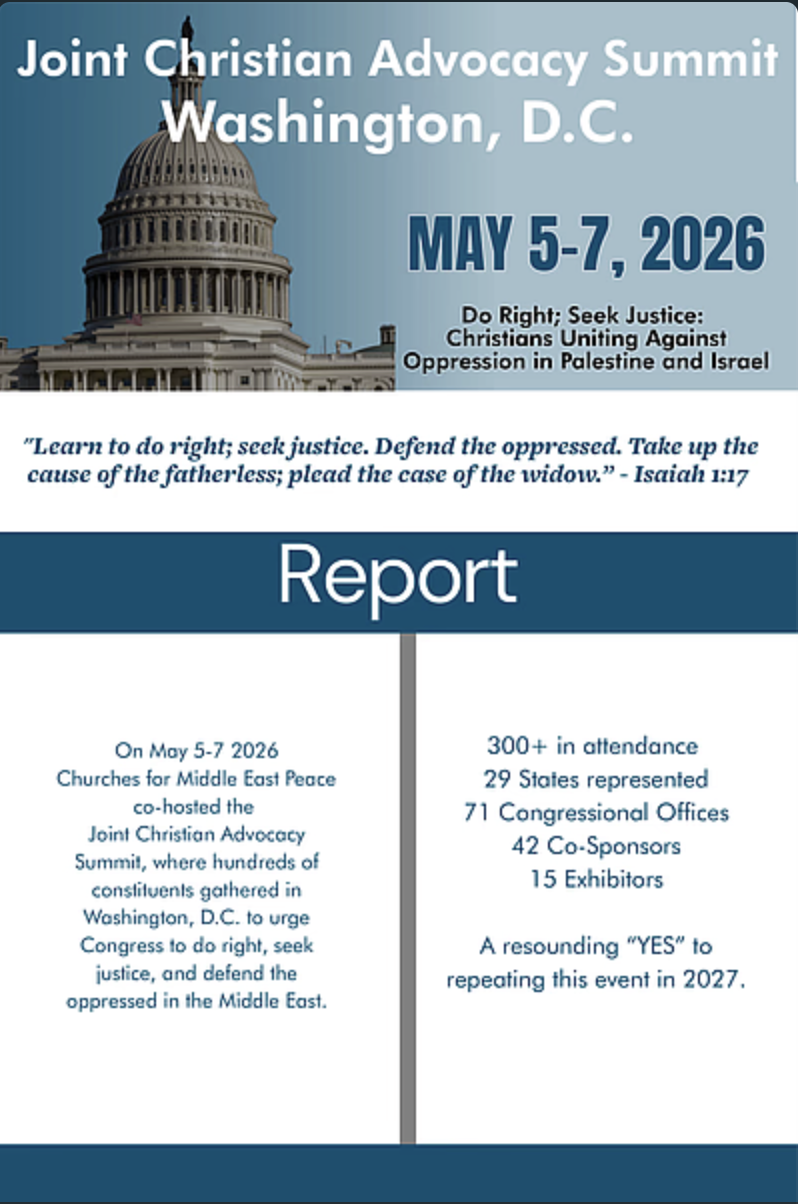
Churches for Middle East Peace co-hosted the Joint Christian Advocacy Summit May 5-7 2026, where hundreds of constituents gathered in Washington, D.C. to urge Congress to do right, seek justice, and defend the oppressed in the Middle East. Learn more about the summit in our event report here.
Please join us on Zoom for a weekly briefing on current news regarding the Hamas and Israel War. Hear from CMEP Staff and other experts and ask questions at the end. Every Thursday from 10:30-11:15 am Eastern.
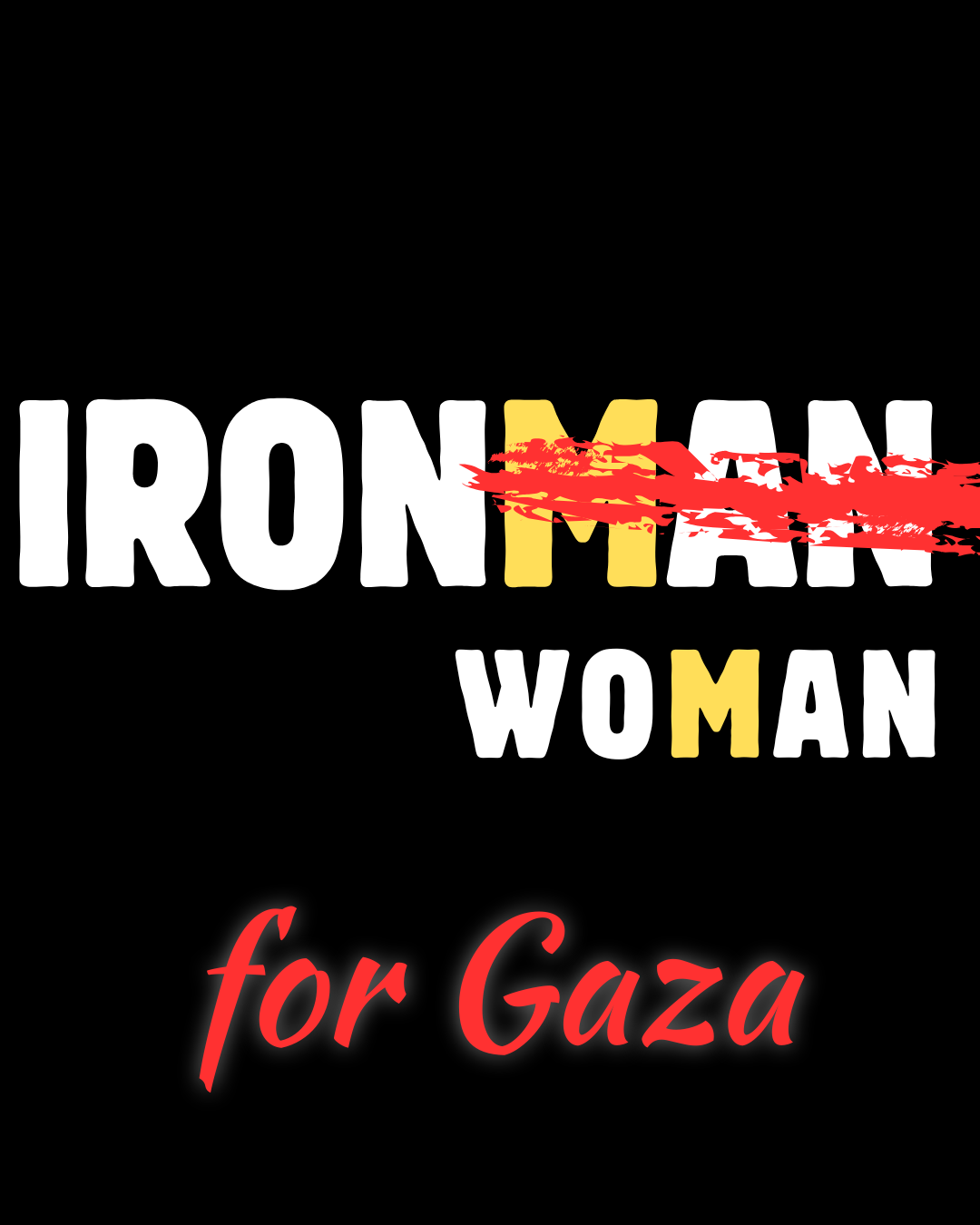
We are not giving up on pursuing peace! And CMEP's executive director persists in pursuit of completing a 140.6 IronMan triathlon on behalf of Gaza. "Persistence is an essential quality for peace. I have learned that lesson again and again in life, and never more so than in my pursuit of a deeply personal and transformative journey — one that challenges me both physically and emotionally. Through my training for, and eventual completion of, an Ironman Triathlon, I aim to raise $140,600 to support a cause that is close to my heart: bringing freedom, justice, and peace to the Middle East."- Rev. Dr. Mae Elise Cannon, Executive Director of CMEP
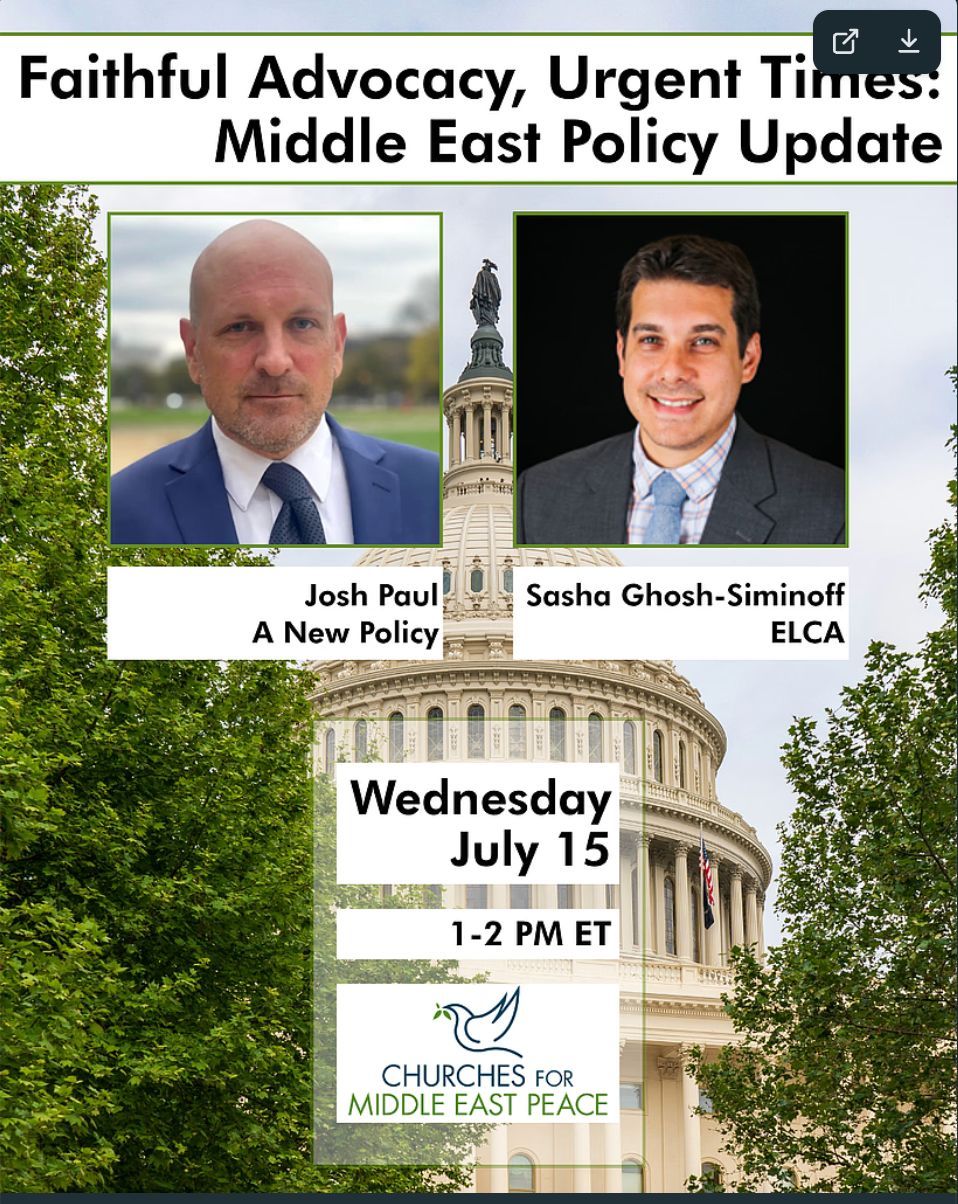
July 15, 2026: Faithful Advocacy, Urgent Times: Middle East Policy Update
Time: 1:00 pm - 2:00 pm ET
On July 15th at 1PM EST join Churches for Middle East Peace (CMEP) and DC-based experts Sasha Ghosh-Siminoff (ELCA) & Josh Paul (A New Policy) for the latest updates from Capitol Hill relating to U.S. policies impacting Israel, Palestine, and the broader Middle East. Beyond providing the latest landscaping, speakers will also offer advocacy action steps and specific advice for outreach to congressional offices on key legislative priorities.
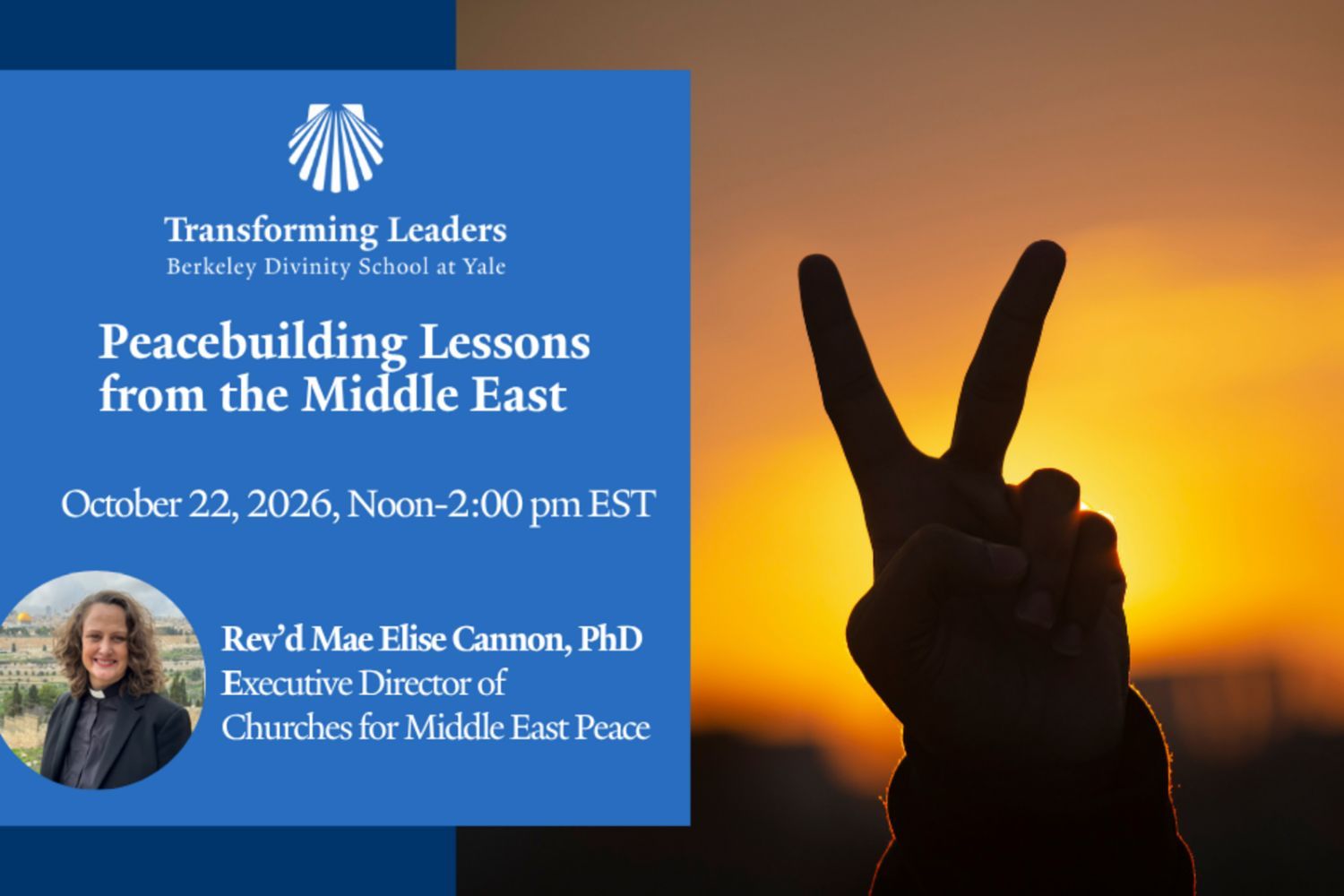
October 22, 2026: Peacebuilding Lessons from the Middle East
Time: 12:00 pm - 2:00 pm ET
This moment in history is marked by profound brokenness and trauma affecting individuals, communities, and nations alike. In a world increasingly divided by conflicts, particularly in the Middle East, Christians from the region offer invaluable insights on resiliently living out one’s faith amidst adversity. Join Churches for Middle East Peace executive director, Rev. Dr. Mae Elise Cannon, for this course exploring the vibrant, living church in the Holy Land, with a focus on Israel and the occupied Palestinian territories as they strive to deepen their relationship with God through their commitment to peace and justice within their communities. This workshop takes an interdisciplinary approach, interweaving history, practical theology, and contemporary ministry practices in peacebuilding. Participants will gain access to essential tools for spiritual formation and advocacy applicable in a variety of ministry settings. A central theme will be the transformative journey of learning to 'love one’s enemy,' even in the face of conflict and strife, ultimately equipping learners to apply these lessons in their own lives and ministries.
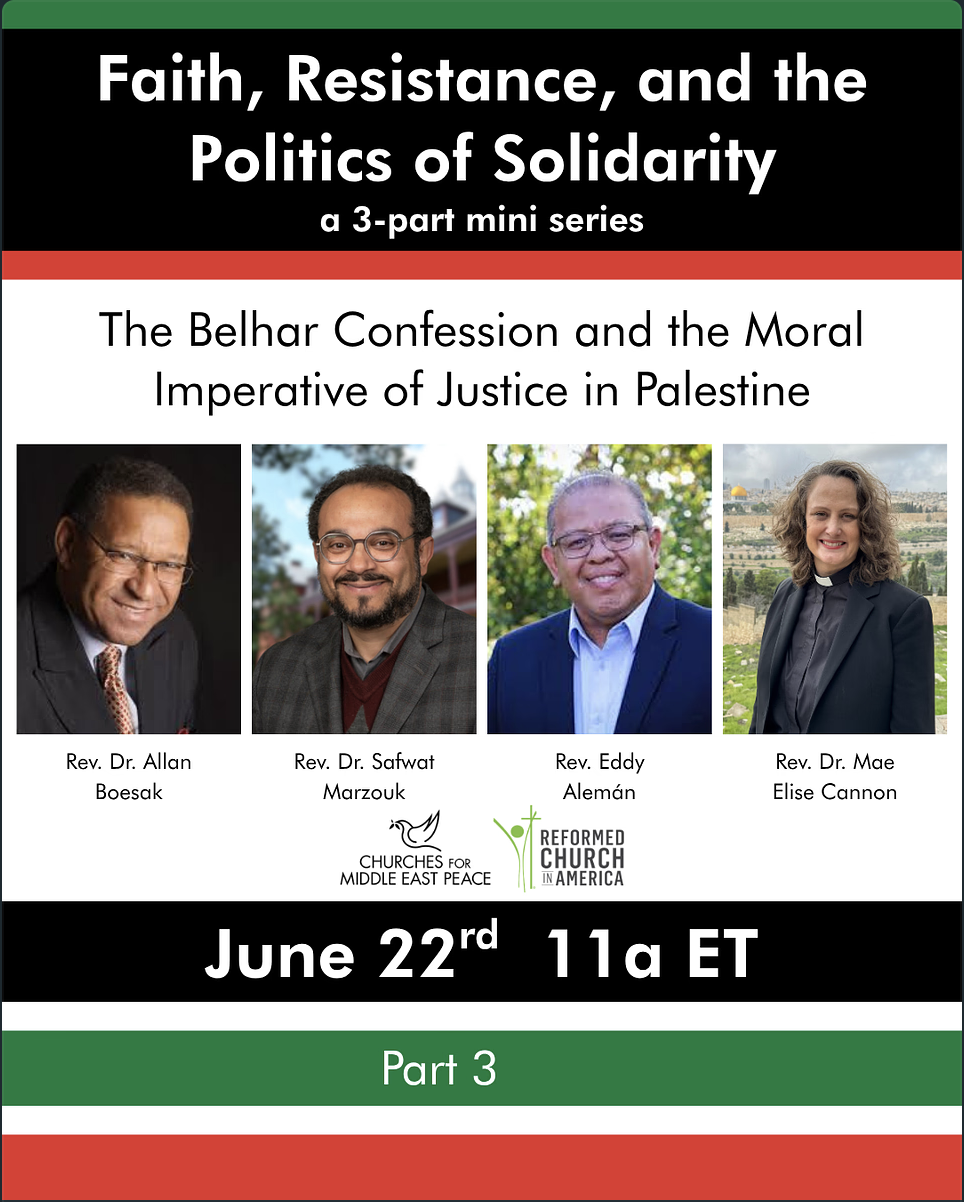
Session 3: The Belhar Confession and the Moral Imperative of Justice in Palestine
Date: June 22 Time: 11:00 AM–12:15 PM ET
On June 22, CMEP hosted the third session in its webinar series exploring the intersections between South African and Palestinian justice movements, The Belhar Confession and the Moral Imperative of Justice in Palestine. Facilitated by Executive Director Rev. Dr. Mae Elise Cannon, the conversation featured Rev. Eddy Alemán, Rev. Dr. Allan Boesak, and Rev. Dr. Safwat Marzouk. Together, the speakers examined the enduring significance of the Belhar Confession as a theological call to unity, justice, and reconciliation. Drawing connections between South Africa's anti-apartheid struggle and the realities facing Palestinians today, the panel explored how the confession continues to challenge churches to confront injustice and stand in solidarity with oppressed communities. View a recording of the event here.