Here’s what’s upcoming and what you may have missed at CMEP and in the news.
Middle East News
1. Kuwait says Iranian drones hit airport and killed 1 as ceasefire is tested again
AP News
"Iranian drones heavily damaged a passenger terminal at Kuwait’s main airport Wednesday, killing one person, wounding dozens and briefly closing the airfield — the latest in back-and-forth attacks by Iran and the U.S. that test a fragile ceasefire. The strike reinforced the risks to residents and travelers in Gulf countries that had considered themselves relative havens before the U.S.-Israeli war with Iran. Iran denied causing the damage. Talks have dragged on for weeks as mediators seek a more enduring truce in the war, now in its fourth month. They are increasingly strained by Israel’s broadening war with Iran-backed Hezbollah militants in Lebanon."
2. Israeli strikes kill three people in Gaza, as truce talks stall
Reuters
"Israeli strikes killed three Palestinians in Gaza on Wednesday, health officials said, and the Palestinian militant group Hamas said ending such attacks was crucial to further talks on safeguarding a U.S.-brokered ceasefire."
3. Over 2,100 West Bank settlement housing units advance in planning process
The Times of Israel
"The construction of 2,162 housing units in three West Bank settlements was approved Wednesday by the Higher Planning Council of the Civil Administration, a department of the Defense Ministry, in a move that far-right Finance Minister Bezalel Smotrich said 'solidifies' Israel’s hold of the territory. The committee approved 1,006 units for Gvaot in the Gush Etzion region of the West Bank, south of Jerusalem, in one of the most important stages of the planning process, which will massively expand the settlement — where several dozen families currently live — and create homes for thousands of new residents."
4. Israeli forces detain four female Birzeit University students near Ramallah
The New Arab
"Israeli forces have detained four female Birzeit University students following a series of overnight raids across the Ramallah area as part of a growing pattern of targeting students and academic institutions in the occupied West Bank."
5. "You're f*cking crazy": Trump fumes at Netanyahu in call on Lebanon
Axios
"President Trump lashed out at Israeli Prime Minister Benjamin Netanyahu over Israel's escalation in Lebanon in an expletive-laden call on Monday, two U.S. officials and a third source briefed on the call told Axios. Earlier on Monday, Iran threatened to abandon the negotiations with the U.S. over Israel's actions in Lebanon. On the call, Trump called Netanyahu "crazy" and accused him of ingratitude, according to two of the sources. He also put the brakes on Israel's plan to strike Beirut."
6. Israel strikes southern Lebanon despite Trump’s effort to shore up ceasefire
The Guardian
"Israeli warplanes have launched dozens of strikes across southern Lebanon despite a new agreement supposedly brokered by Donald Trump aiming to bolster the tattered ceasefire in Lebanon. The US president said on Monday that he had stopped an imminent Israeli strike on Beirut and that he had spoken to Israel’s prime minister, Benjamin Netanyahu, and representatives of Hezbollah and both agreed that 'all shooting will stop.' But on Tuesday, Lebanon’s state-run National News Agency reported 30 Israeli strikes across the south. Near the city of Sidon, rescuers recovered the bodies of six members of the same family, including two children and a woman, after an Israeli strike."
"Israel and Lebanon have agreed to implement a ceasefire that would require a 'complete cessation' of fire by Hezbollah, according to a joint statement after US-led talks in Washington, DC. The two countries, which do not have formal diplomatic relations, also agreed on Wednesday to create 'pilot zones,' in which the Lebanese armed forces 'will take exclusive control of the territory to the exclusion of all non-state actors.' The development came despite continued cross-border attacks earlier in the day as Hezbollah said it targeted Israeli soldiers and Israeli strikes killed at least 10 people in southern Lebanon."
"A recent violent and unprovoked attack on a French nun in Jerusalem has cast a spotlight on the rising hostility toward Christian communities in Israel. In a viral video from April 28, a man runs up to a nun and forcefully pushes her onto the street, causing her to narrowly miss hitting her head on a stone. The man then kicks the nun as she lies on the ground, stopping only after a passerby intervened."
June 5, 2026: CMEP is deeply alarmed by the recent arrest and detention of four Palestinian university students by Israeli forces in the occupied West Bank
Churches for Middle East Peace (CMEP) is deeply alarmed by the recent arrest and detention of four Palestinian university students by Israeli forces in the occupied West Bank. According to local reports, Israeli forces raided homes in Birzeit and Beitunia before detaining students Natalie Abu Diya, Joulan Abu Awwad, Sama Safi, and Laila Khalil. These arrests are part of a broader and deeply troubling pattern of arbitrary detention and escalating military raids throughout the occupied West Bank.
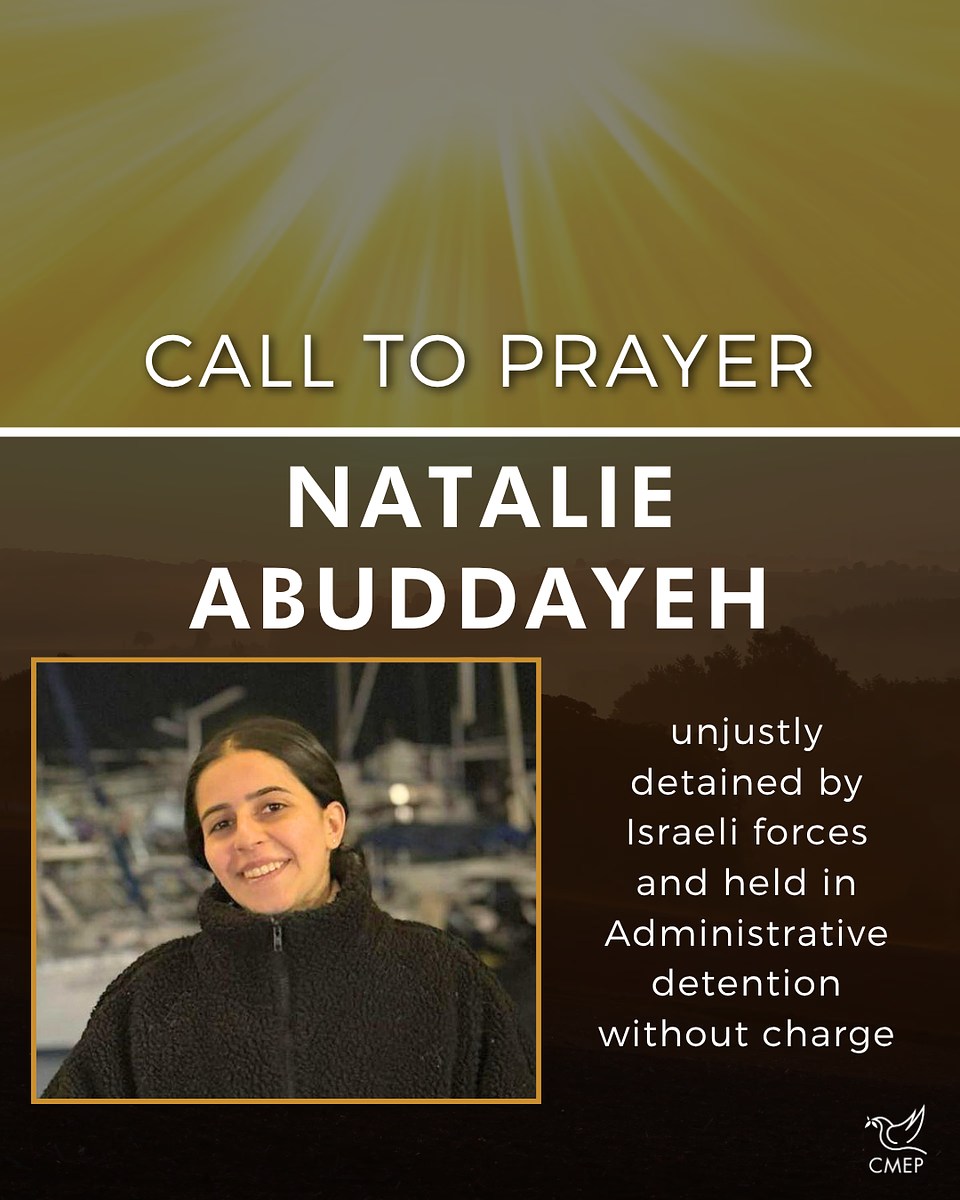
June 4, 2026: CMEP Call to Prayer: Natalie Abu Dayyeh
CMEP calls its supporters to pray for Natalie Abu Dayyeh, a 20-year-old Christian-Palestinian university student who was arrested by Israeli forces on June 1st 2026. The family and lawyer have not been allowed direct access to Natalie, nor have they been informed about why she has been arrested. Natalie is being held under administrative detention, which allows Israel to hold Palestinians indefinitely without charge or trial. We ask that you keep Natalie in your prayers as we hope and pray for her release. Join us every Wednesday at 12:30 EST to join the CMEP community as we pray for Natalie and peace in the Holy Land.
CMEP calls on our supporters to take action by contacting their members of Congress and urging them to advocate for the release of Natalie and other Palestinians held without charge or trial. Call the U.S. Capitol Switchboard at (202) 224-3121 and ask to be connected to your representatives and senators. After making your call, please email [email protected] to let us know that you took action and to help us track advocacy efforts.
Please join us on Zoom for a weekly briefing on current news regarding the Hamas and Israel War. Hear from CMEP Staff and other experts and ask questions at the end. Every Thursday from 10:30-11:15 am Eastern.
May 27, 2026: An Interview With The Province II of the Episcopal Church and Rev. Dr. Mae Elise Cannon
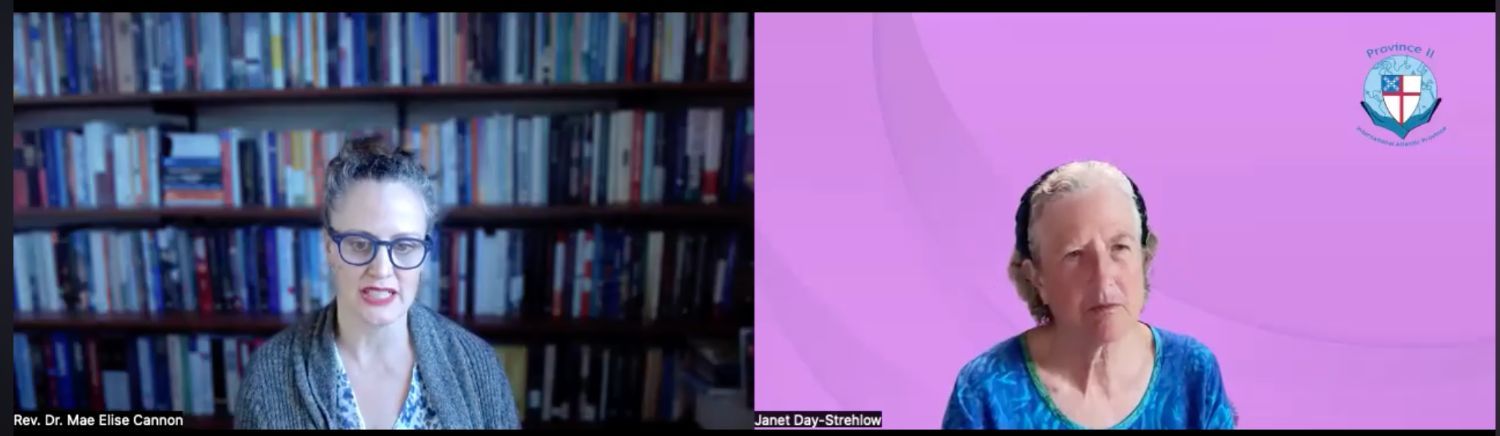
On May 27th, CMEP Executive Director Rev. Dr. Mae Elise Cannon was interviewed by Janet Day-Strehlow to discuss the crisis of internally displaced persons across the Middle East. Cannon highlighted that more than 24 million people have been uprooted from their homes in recent years, including over 1.5 million people in Gaza, where more than 90% of the population has been displaced more than once. Additionally, Cannon spoke of the displacement in the northern West Bank, southern Lebanon, and Iran, where tens of thousands of people remain unable to return to their homes. Nevertheless, Cannon emphasized the importance of both raising awareness about these atrocities and advocating for peace.
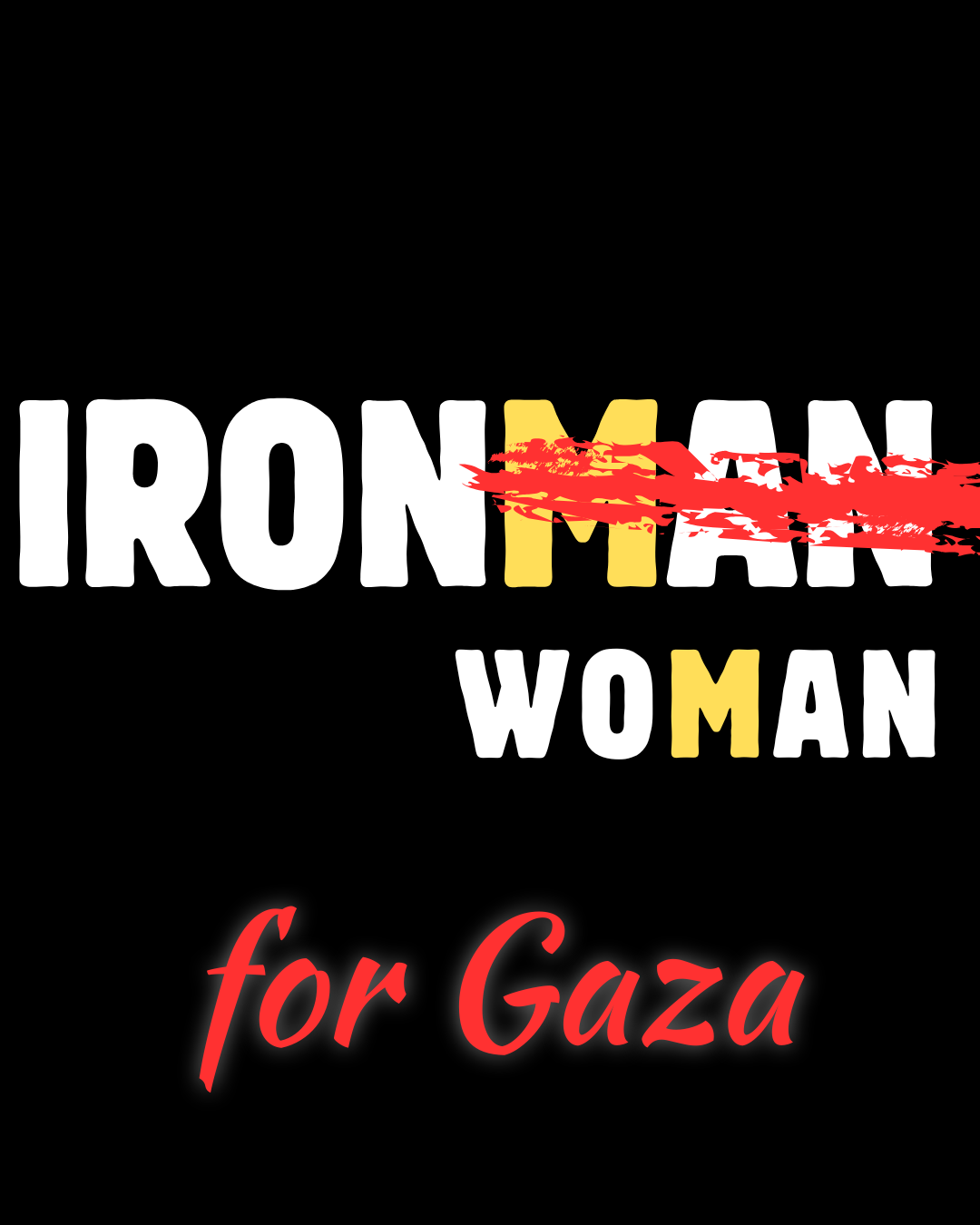
We are not giving up on pursuing peace! And CMEP's executive director persists in pursuit of completing a 140.6 IronMan triathlon on behalf of Gaza. "Persistence is an essential quality for peace. I have learned that lesson again and again in life, and never more so than in my pursuit of a deeply personal and transformative journey — one that challenges me both physically and emotionally. Through my training for, and eventual completion of, an Ironman Triathlon, I aim to raise $140,600 to support a cause that is close to my heart: bringing freedom, justice, and peace to the Middle East."- Rev. Dr. Mae Elise Cannon, Executive Director of CMEP
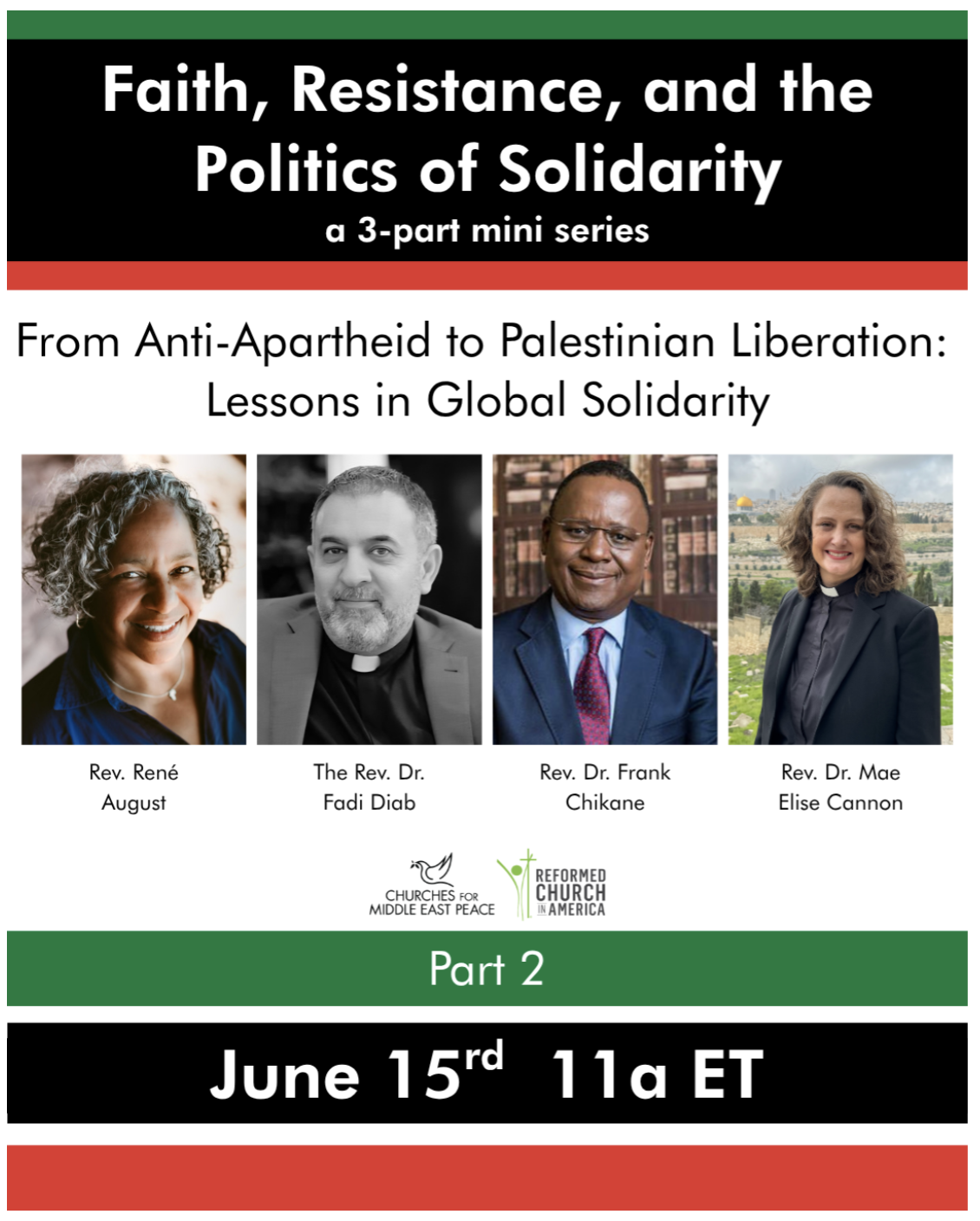
June 15, 2026: Session 2: APARTHEID: Faith, Resistance, and the Politics of Solidarity
Time: 11:00 AM–12:15 PM ET
This webinar is facilitated by CMEP's executive director, Rev. Dr. Mae Elise Cannon, and features critical voices in the current conversation about the U.S., South Africa, and Palestine, including South African anti-apartheid activists Rev. Dr. Frank Chikane and Rev. René August, and Palestinian Christian Father Fadi El Diab. The session examines apartheid as a political, legal, and theological system. Drawing on South Africa’s history of racial segregation and liberation, speakers will explore how apartheid is defined, how systems of domination and exclusion are sustained, and why the language of apartheid remains central to debates about justice in Palestine and Israel today. The conversation will consider the role of churches and faith leaders in resisting oppression and advancing movements for dignity, equality, and liberation.
Jun 28 2026: (Chicago) Destiny Magnett Guest Sermon at Missio Dei Uptown
Time: 10:00 am - 12:00 pm
Destiny Magnett is the Programs and Outreach Manager at Churches for Middle East Peace (CMEP) where she serves as the primary liaison for church partners, oversees CMEP’s online and in-person educational programming, and co-leads the grassroots regional coordinator network. Grounded in deep commitments to justice, she draws from her own ecumenical Christian identity to help diverse American Christian communities deepen their understandings of the Middle East through storytelling, theological and scriptural investigation, and dialogue. Destiny holds an MTS and Religion & Public Life Certificate from Harvard Divinity School, where her work focused on decoloniality, religious ethics, peacebuilding, and religion in the public sphere. She also holds a B.A. in Religious Studies from Grinnell College.
June 3, 2026: Faith, Resistance, and the Politics of Solidarity Part 1: "White Genocide" and Real Genocide: South Africa, Palestine, and the Politics of Fear
Featuring Rev. Dr. Munther Isaac, Pastor Rudi Swanepoel, Rev. Edwin Arrison, and Rev. Dr. Mae Elise Cannon, the opening session examined the political and theological power of competing narratives around violence, victimhood, and oppression in South Africa and Palestine. As claims of a so-called “white genocide” in South Africa continue to circulate globally despite widespread criticism from scholars and human rights advocates, Palestinians and international observers have increasingly raised urgent alarms about the realities of mass displacement, collective punishment, and genocide in Gaza. Grounded in the lived experiences of South African and Palestinian leaders, the session invited participants to wrestle with questions of justice, solidarity, and the ethical use– and misuse– of the language of genocide.