Here’s what’s upcoming and what you may have missed at CMEP and in the news.
Middle East News
1. Netanyahu orders Israeli army to seize ‘70% of Gaza Strip’, violating ceasefire deal
The Guardian
"Benjamin Netanyahu has said he has given orders to the Israeli army to seize control of 70% of the Gaza Strip in a move that threatens to torpedo an already fragile ceasefire and create catastrophic humanitarian conditions in the already devastated territory. Under the US-brokered ceasefire in October, the Israeli army withdrew to a demarcation line which gave Israel direct control of 53% of the occupied territory. Since then, Israeli forces have steadily advanced their positions westward into the Hamas-controlled half of the strip, and declared an ever-expanded no man’s land west of that, within which they claim the right to decide who can enter and open fire on anyone perceived as a threat".
2. Van Hollen says Democrats’ Israel-Palestine strategy ‘has failed’
The Hill
"Sen. Chris Van Hollen (D-Md.) slammed the Democratic Party’s strategy surrounding the conflict between Israel and Palestine, claiming they “need to face a hard truth.” “While Republicans’ approach to the Israeli-Palestinian conflict has failed, so has ours,” Van Hollen wrote Tuesday in an opinion piece published by The New York Times."
3. Iran says it targeted American base after fresh US strikes
BBC News
"Iran's Islamic Revolutionary Guard Corps (IRGC) has said it targeted an American air base in the region, after fresh US strikes on southern Iran overnight. Kuwait, which hosts a US base, said it had intercepted "hostile missile and drone threats", but did not confirm the target. The Iranian missile launch came after the US shot down Iranian drones over the Strait of Hormuz and struck a military site in Bandar Abbas, a strategic port city in southern Iran".
4. U.S. and Iran reach deal but need Trump's final approval, officials say
Axios
"U.S. and Iranian negotiators have reached an agreement on a 60-day memorandum of understanding to extend the ceasefire and launch negotiations on Iran's nuclear program, but President Trump has yet to give his final approval, two U.S. officials and a regional source involved in the mediation efforts tell Axios. Iran has also not confirmed its acceptance".
5. Israeli military strikes southern suburb of Beirut before crucial Lebanon-Israel talks in Washington
AP News
"Israel’s air force carried out an airstrike on a southern suburb of Lebanon’s capital on Thursday afternoon, the Israeli military said, further straining a fragile ceasefire a day before crucial negotiations in Washington. The strike hit an apartment building, but the target of the attack wasn’t immediately clear. White smoke billowed from a residential neighborhood in the suburb of Choueifat, close to Beirut’s international airport".
6. How Israel has emptied southern Lebanon far beyond the front lines
Reuters
"The ceasefire agreed in Lebanon last month has brought little respite for civilians, who are being driven from a steadily expanding swathe of the country by a relentless Israeli campaign of evacuations and air strikes. The U.S.-brokered truce announced on April 16, after about six weeks of fighting, has failed to halt the violence between Israel and Hezbollah. Both are carrying out near-daily attacks while accusing the other of violating the pact. That’s left hundreds of thousands of civilians in southern Lebanon displaced from their homes".
7. ‘Eid does not enter tents’: Palestinians in Gaza face grim holiday
Al Jazeera
"On previous Eid holidays, the Baroud family would set out in the early light of dawn to kick off festivities, driving through the streets of Shati refugee camp in Gaza City, visiting homes of relatives, and sharing the meat of a sacrificial animal among family members. At the end of each holiday, they took an annual family photo – a fixed ritual every Eid – and shared it with relatives abroad. However, on Eid today, amid Israel’s genocide against Palestinians in Gaza, Walaa Baroud sits before the last version of that photo, holding it in his hands as the only memory of a time that has passed".
8. Pope Leo’s ‘Magnifica humanitas’: AI must serve humanity not concentrate power
Vatican News
“Humanity, created by God in all its grandeur, is today facing a pivotal choice: either to construct a new Tower of Babel or to build the city in which God and humanity dwell together.” The opening words of Pope Leo XIV’s first encyclical, Magnifica humanitas: On Safeguarding the Human Person in the Time of Artificial Intelligence, summarize its underlying reasons and purpose. Published on Monday, May 25, the Pope signed the encyclical on May 15, the 135th anniversary of the promulgation of Pope Leo XIII’s Rerum novarum".
Please join us on Zoom for a weekly briefing on current news regarding the Hamas and Israel War. Hear from CMEP Staff and other experts and ask questions at the end. Every Thursday from 10:30-11:15 am Eastern.
May 28, 2026: P4P A Jerusalem Voice for Justice: In These Turbulent Times
In this P4P, the Christian religious officials of Jerusalem stand together to ask that readers not accept war as a natural solution to problems in the Holy Land. The only outcome of war will be suffering for civilians and the innocent, which runs counter to the teachings of Christianity. In the land where Jesus was born, taught, and rose from the dead, peace must be championed.
Support CMEP’s Work for Peace If you value the programs and advocacy efforts highlighted in the bulletin, we invite you to partner with us. Your generosity makes it possible for CMEP to continue hosting events, leading education initiatives, and amplifying voices for justice and peace in the Middle East. If you would like to support CMEP in expanding this important work, please consider making a donation today. Thank you for standing with us.
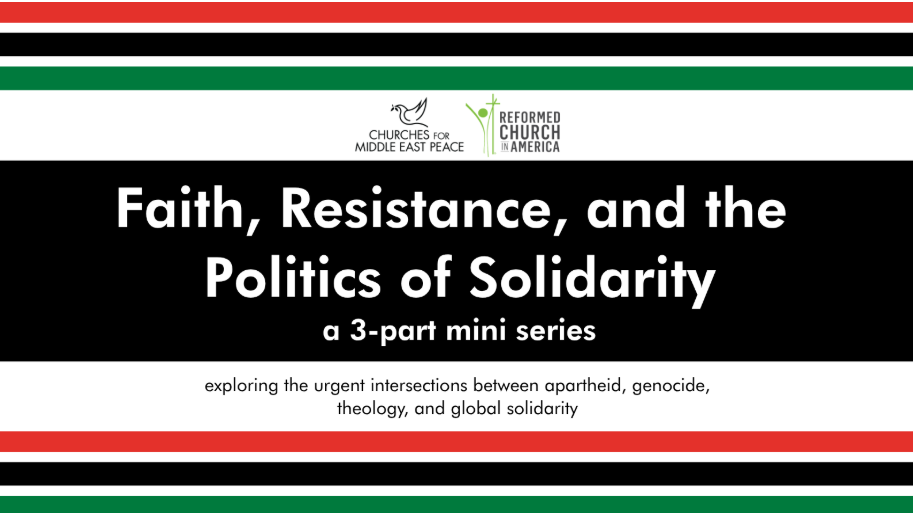
June 3, 2026: Faith, Resistance, and the Politics of Solidarity Part 1: "White Genocide" and Real Genocide: South Africa, Palestine, and the Politics of Fear
Featuring Rev. Dr. Munther Isaac, Pastor Rudi Swanepoel, Rev. Edwin Arrison, and Rev. Dr. Mae Elise Cannon, the opening session examines the political and theological power of competing narratives around violence, victimhood, and oppression in South Africa and Palestine. As claims of a so-called “white genocide” in South Africa continue to circulate globally despite widespread criticism from scholars and human rights advocates, Palestinians and international observers have increasingly raised urgent alarms about the realities of mass displacement, collective punishment, and genocide in Gaza. Grounded in the lived experiences of South African and Palestinian leaders, the session invites participants to wrestle with questions of justice, solidarity, and the ethical use– and misuse– of the language of genocide.